
37% of Adopted Dogs Are Returned Within 7 Days — Here's Exactly Why
It's Day 3.
The dog won't stop barking when you leave the room. She chewed through the corner of the couch. She hasn't eaten since she got home. And you're starting to wonder — quietly, with a lot of guilt — if you made a terrible mistake.
You didn't. But something did go wrong. And it happened before you ever walked through that shelter door.
Every year in America, millions of families adopt a dog with the best intentions. And every year, 37% of those dogs are back at the shelter within seven days.
Not because the families were bad people. Not because the dogs were broken. But because nobody — not the shelter, not the family — stopped to ask the right questions before the match was made.
This article is about what actually happens in those seven days, why it happens, and what changes when you get the match right from the beginning.
What Actually Happens in the First Seven Days
When a dog arrives in a new home, their entire world has changed overnight.
Their scent markers are gone. Their routine is gone. The people, the sounds, the smells, the rules — all of it is new. For a dog, that is not exciting. That is terrifying.
What families often see in the first week isn't the dog's true personality. It's a dog in survival mode.
Some dogs go quiet and hide. Some dogs become velcro — following you from room to room, unable to settle. Some dogs who seemed calm and friendly at the shelter start barking, growling, or lunging. Some dogs stop eating entirely.
None of this means the dog is broken. It means the dog is adjusting.
But here's the problem: most families don't know this is normal. They adopted a dog expecting the Instagram version — happy, playful, grateful. What they got was a scared animal doing what scared animals do.
And so within seven days, 37% of them return that dog to the shelter.
The 3-3-3 Rule — What shelters wish they told you before you left:
3 DAYS to decompress. The dog is overwhelmed and just surviving.
3 WEEKS to learn your routine. They start to understand what life here looks like.
3 MONTHS to feel at home. Their true personality comes out. The real relationship begins.
Most returns happen before the first 3 days are even over.
The Real Reasons Dogs Get Returned — The Data
Shelters track this. And the numbers tell a very specific story.
Most people assume dogs are returned because they're aggressive or uncontrollable. The reality is more nuanced — and more preventable.
Notice what's at the top of that list. Housing. Too many pets. Behavior surprise. Finances. Time.
Almost none of those are about the dog being bad. Almost all of them are about the match being wrong.
The family didn't know the dog was high-energy before they signed the papers. The landlord's breed restriction wasn't checked until after adoption. The existing cat was never introduced properly. The $3,000 vet bill in month two was a complete shock.
These are not surprises that have to happen. They are mismatches that good matching prevents.
What shelters often can't tell you — and why:
Most shelters are understaffed and at capacity. They do their best. But a dog that's been in a kennel for 3 weeks is showing kennel behavior — not home behavior. The playful dog at the shelter might be the anxious dog in your apartment. The calm dog might be shut down from stress. Shelters assess dogs, but they can't fully predict how a dog will behave once they settle in. That's why pre-adoption matching — understanding your life before choosing the dog — matters so much.
The "Nuisance Behavior" Problem

Shelters call them nuisance behaviors. Barking, jumping, pulling on the leash, counter-surfing, getting into the trash, not listening.
These are the #1 reported reason dogs are returned — even above aggression.
Here's what most families don't realize: nuisance behaviors are almost always normal dog behavior in a dog that hasn't been trained. And whether that training is manageable depends almost entirely on the owner's experience level and the dog's breed tendencies.
A Beagle that follows its nose and ignores commands isn't being bad. It's being a Beagle. A Labrador that jumps on every person it meets isn't aggressive. It's a high-energy young dog that's never been taught otherwise.
The problem isn't the behavior. The problem is the expectation gap between what the owner thought they were getting and what they actually got.
Common nuisance behaviors — and what they really signal:
Usually separation anxiety, boredom, or territorial instinct — highly breed-dependent Excessive barking
Excitement and lack of training — more common in high-energy breeds Jumping on people
Strong prey drive or high energy — some breeds need structured leash work for months Pulling on leash
Anxiety, boredom, or teething in young dogs — not spite Chewing and destruction
Not stubbornness — usually insufficient training time or a breed wired for independence Ignoring commands
A common shelter behavior that usually resolves with patience — but needs experience to handle Food aggression
None of these behaviors are dealbreakers with the right preparation. All of them feel overwhelming when you didn't expect them.
The Expectation Gap:
90% of owners who returned a dog citing 'aggressive behavior' reported the behavior came as a complete surprise. They had no warning. They had not been matched to a dog whose known behaviors aligned with their ability to manage them. Surprise is the enemy of successful adoption. Matching is the solution.
Related Reading


What the Shelter Couldn't Tell You — And What PetMatch Can
This is important to understand, and it's not a criticism of shelters. Shelters do extraordinary, often heartbreaking work with limited resources.
But a shelter assessment has real limits.
A dog that's been in a kennel for two weeks is stressed. They're not sleeping properly. They're surrounded by noise. They may be shut down emotionally or amped up in ways that don't reflect their actual personality in a home environment.
Shelters do their best to assess temperament. But what they can tell you is a snapshot — not a full picture. And even a full picture of the dog doesn't tell you if that dog fits your life.
That's the gap PetMatch fills.
Instead of starting with the dog and hoping it works — PetMatch starts with you. It maps your daily life, your home, your experience, your family, your expectations. Then it matches you to dogs whose known temperament, energy, and care needs are compatible with what your life can actually offer.
It doesn't eliminate the adjustment period. No tool can do that. But it does mean that when the dog acts like a dog, you already know what to expect — and you've been matched to a dog whose "dog behavior" you can actually handle.
The Matching Difference — What changes when you match first:
WITHOUT MATCHING: Fall in love with the dog -> Adopt -> Realize needs don't align -> Struggle or return
WITH MATCHING: Understand your life -> Find compatible dogs -> Meet with realistic expectations -> Build the relationship through the adjustment -> Keep the dog
The dog is the same. The outcome is completely different.
What Successful Adopters Do Differently
After years of shelter data and behavioral research, a clear pattern emerges. Families who successfully keep their dogs — who make it through the 7-day cliff, the 3-week adjustment, and into the 3-month real relationship — tend to do a few specific things.
They are not all experienced dog owners. Some of the most successful adopters were first-timers. What they had in common wasn't experience. It was preparation.
1. They researched the breed — not just the look
They read about energy levels, common health issues, training difficulty, and what the breed was originally bred to do. A herding dog that nips at your kids' heels is doing what it was born to do. That's not a flaw — it's a match problem.
2. They planned the first two weeks
Successful adopters treat the first two weeks like a new baby coming home. They clear the schedule where possible, set up a designated safe space for the dog, agree on house rules before the dog arrives, and commit to a consistent routine from day one.
3. They set realistic expectations
They knew the dog would struggle at first. They knew there would be accidents, some barking, some chaos. They weren't surprised. And because they weren't surprised, they didn't panic.
4. They knew their limits going in
They were honest about what they could handle. A family that knew they couldn't manage a high-drive dog didn't get a high-drive dog. A first-time owner who wasn't ready for a reactive rescue chose a more settled adult dog instead. They matched their capacity to the dog's needs.
5. They asked for help early
When something felt off, they called a trainer or behaviorist before the situation escalated. Early intervention on behavior issues is dramatically more effective than trying to fix an entrenched problem months later.
If You're In the First Seven Days Right Now
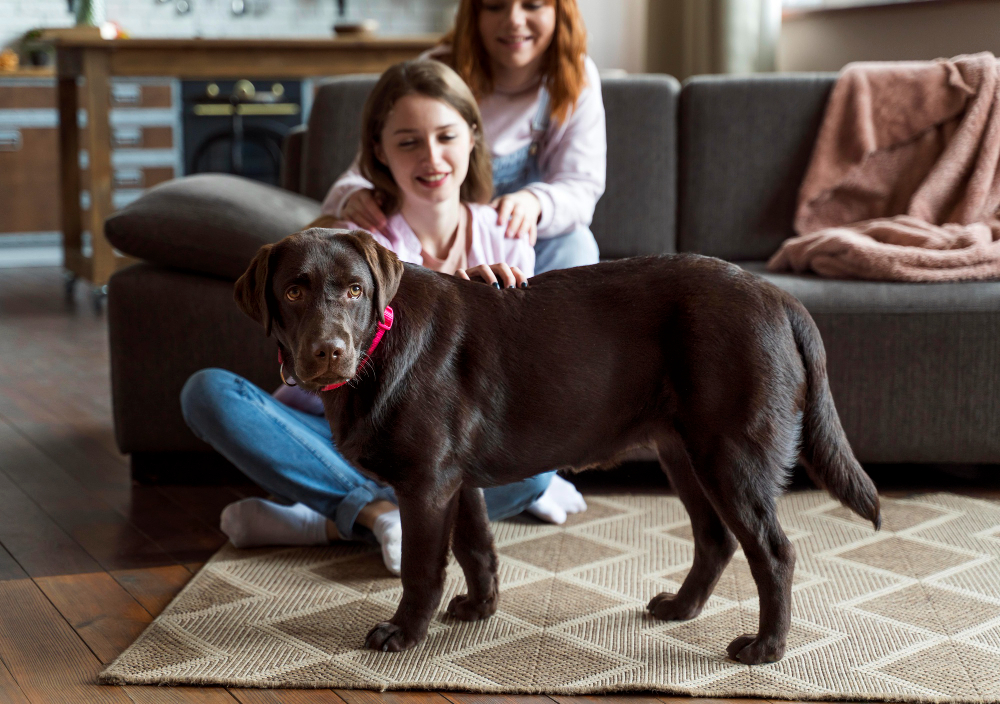
If you're reading this because you're in that first week and things feel hard — stay with it.
Give your dog time. Give yourself grace. The dog you fell in love with is still in there. They're just scared right now.
Here's what to do today:
Give the dog a quiet, safe space that is just theirs — a crate, a corner, a room. Don't force interaction.
Establish a simple routine. Same wake time, same walk time, same feeding time. Predictability is medicine for an anxious dog.
Limit visitors for the first week. New smells and voices add stress to an already-overwhelmed animal.
Don't punish behavior you don't understand yet. Mark what you want more of, and redirect what you want less of.
Call a certified trainer or your vet if you see behavior that worries you. Don't wait.
Read about the 3-3-3 rule. Print it out. Put it on your fridge.
And if you haven't adopted yet — this is exactly why matching before you adopt matters so much. The families who struggle least in the first seven days are the ones who knew what was coming — because they chose the right dog for their real life before they ever walked through the shelter door.
The Bottom Line
37% in seven days. That number should not be acceptable. And it doesn't have to be.
Most of those returns happen because the match was wrong before it started. Not because the dog was wrong. Not because the family was wrong. Because nobody helped them figure out if they were right for each other.
That is exactly the problem PetMatch.ai was built to solve.
Take two minutes before you fall in love. Answer the questions honestly. Find the dog whose needs actually align with your life. Then go meet them — knowing what you're getting into, and knowing you can give them what they need.
That's how you get a dog that stays.
Comments (0)
No comments yet. Be the first to share your thoughts!