New Dog Chaos: Why the First 30 Days Make or Break the Relationship
They are not being difficult. They are terrified. And the clock is ticking.
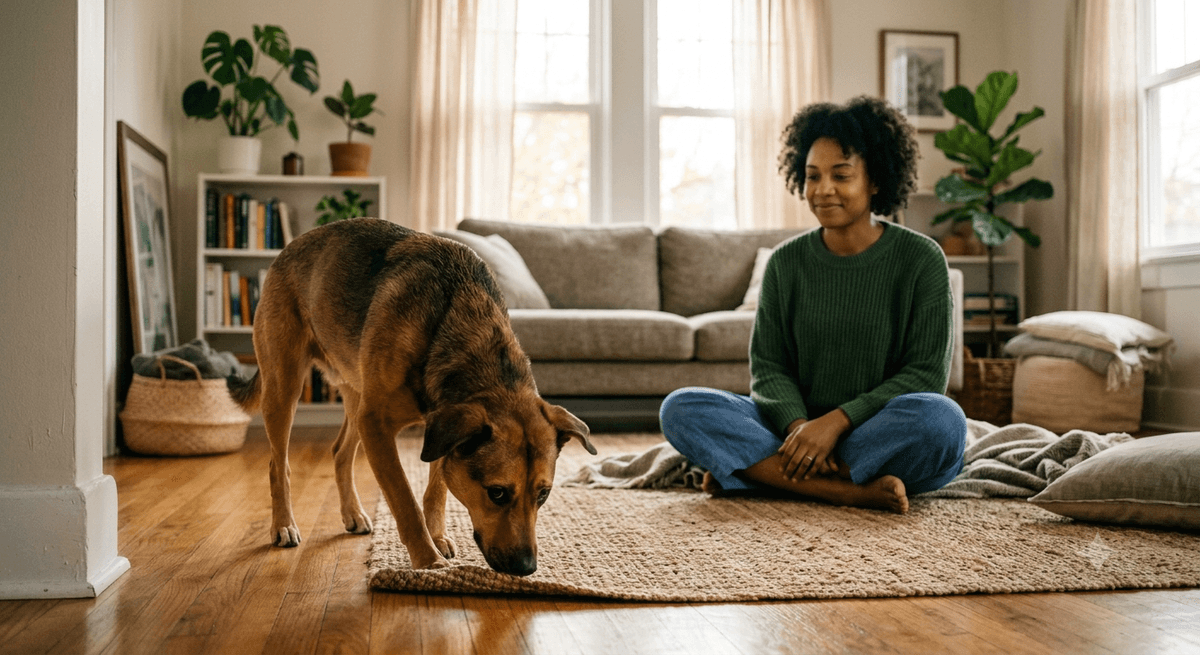
Every dog who comes home for the first time — whether an 8-week-old puppy or a 6-year-old rescue — enters a state of profound disorientation. New smells. New sounds. New rules nobody has explained. New people whose expressions and tones they have not yet learned to read.
What most new owners see in those first days is not the dog's real personality. It is a dog in survival mode, trying to figure out whether this new world is safe.
How a family responds during this exact window — the first 30 days — shapes the entire trajectory of the relationship that follows. Get it right, and you build a foundation of trust and security that makes everything afterward easier. Get it wrong, or simply not know what is normal, and many families end up overwhelmed, confused, and in the worst cases, back at the shelter within the first week.
This is the roadmap for those first 30 days — what is actually happening, what is normal, and what to do at each stage.
37%
of adopted dogs are returned within 7 days
3-3-3
the rule that explains the entire adjustment arc
90 days
before most dogs feel truly settled and secure
#1
cause of early returns is misreading normal adjustment
Section 1: The 3-3-3 Rule — Your Roadmap for the First 90 Days
Shelters and rescues widely reference a framework called the 3-3-3 rule because it accurately captures the typical emotional arc of a dog settling into a new home. Understanding it before your dog arrives changes everything about how you interpret what you see in those early weeks.
Days 1-3 — Survival Mode
What is happening: Your dog is overwhelmed. They may hide, refuse food, seem unusually quiet, or conversely seem hypervigilant and unable to settle. This is not a preview of their personality — it is shock and disorientation. Many dogs do not show their true selves at all during this window.
What to do: Keep the environment calm and predictable. Limit visitors. Do not force interaction or affection. Let the dog set the pace of approach. Provide a quiet, designated safe space. Resist the urge to judge their personality based on these first 72 hours.
Weeks 1-3 — Testing the Waters
What is happening: The dog starts to learn your routine and test boundaries. This is when real behaviors begin to emerge — some endearing, some challenging. You may see the first signs of the dog's actual personality, along with behavioral testing as they figure out what is and is not allowed.
What to do: Begin consistent training and routine-building now. Establish house rules immediately and enforce them gently but consistently. This is the ideal window to start basic obedience work, since the dog is forming their understanding of how this home works.
Months 1-3 — Settling In
What is happening: By around the three-month mark, most dogs feel genuinely secure in their new home. Their true personality is fully visible. The bond has deepened. Behaviors that were testing or anxious in earlier weeks typically stabilize, assuming consistent training and routine have been maintained.
What to do: Continue reinforcing training. Deepen the relationship through regular exercise, play, and bonding activities. By this point, most families report feeling like the dog has become a true, known member of the household — not a stranger they are still getting to know.
Why This Framework Matters So Much:
The majority of early returns happen during the Days 1-3 or Weeks 1-3 phases — precisely when the dog is least likely to be showing their actual personality. A family who does not know about the 3-3-3 rule may genuinely believe a scared, shut-down dog in survival mode represents who that dog truly is, and make a life-altering decision based on incomplete information.
Section 2: The Most Common First-Month Mistakes
Even well-prepared, loving families make predictable mistakes in the first 30 days — mistakes that are almost always well-intentioned, and almost always fixable once identified.
Too much, too fast
Inviting everyone over to meet the new dog in the first week, taking them to crowded places immediately, or overwhelming them with toys, activities, and stimulation before they have decompressed. The dog needs calm and predictability first, excitement second.
Skipping the safe space
Not establishing a designated quiet area — a crate, a gated room, a specific corner — where the dog can retreat and be left alone. Every dog needs an escape valve during adjustment, and many behavioral issues in the first month stem from a dog who has nowhere to decompress.
Inconsistent rules from day one
Allowing the dog on the couch the first week because they seem sad, then trying to enforce a no-couch rule once they have settled in. Dogs learn through consistency. Decide your house rules before the dog arrives and apply them from hour one, even when it feels less cuddly in the moment.
Misreading fear as aggression, or shutdown as calm
A dog who growls when approached in their safe space during week one is showing fear, not dominance. A dog who seems unusually quiet and "easy" in the first few days is often shut down from stress, not naturally low-energy. Both misreadings lead to mismatched expectations later.
Comparing to a previous dog
Every dog adjusts differently, and comparing a new dog's early behavior unfavorably to a beloved previous pet — consciously or not — creates frustration that has nothing to do with the current dog's actual potential.
Giving up before week three
The most consequential mistake. Many families make a permanent decision about a temporary, expected phase of adjustment. A dog struggling in week one is not necessarily a dog who will struggle in month three.
Section 3: Setting Up Success Before the Dog Even Arrives
The families who navigate the first 30 days most smoothly almost always did meaningful preparation before the dog walked through the door.
Related Reading
Establish house rules as a family — in advance
Where will the dog sleep? Are they allowed on furniture? Which rooms are off-limits? Decide these as a household before the dog arrives, write them down if helpful, and commit to applying them consistently from the very first hour. Changing rules later confuses the dog and undermines training.
Set up the safe space first
Have a crate, gated area, or designated quiet room ready and comfortable before the dog's first moment in the home. This should be the first place you show them, and a space that remains consistently theirs throughout the entire adjustment period and beyond.
Plan the first 72 hours deliberately
If possible, arrange to be home and available — without overwhelming the dog with constant attention — for the first few days. Clear your social calendar. Postpone houseguests. This window deserves your full presence, even if that presence is mostly calm, quiet, and low-key.
Have a vet and trainer identified before you need them
Research and select a veterinarian before the dog arrives, and schedule an initial wellness visit within the first week or two. Identify a certified trainer in your area in advance, so that if early behavioral questions arise, you are not scrambling to find help during an already stressful period.
Buy supplies before, not during, the chaos
Food, bowls, a leash and collar or harness, bedding, basic toys, and cleanup supplies should all be ready in advance. Trying to make a first pet store run with an overwhelmed new dog adds unnecessary stress to an already disorienting day.
Section 4: A Day-by-Day Look at What to Actually Do
The First 30 Days — A Practical Action Guide
Day 1: Keep arrival calm and quiet. Show the dog their safe space immediately. Limit interaction to essential needs. No visitors.
Days 2-3: Continue minimal stimulation. Begin establishing a basic routine for feeding and walks at consistent times. Observe without forcing interaction.
Week 1: Schedule the initial vet visit. Begin very basic training cues (sit, name recognition) in short, low-pressure sessions. Start introducing the dog to your immediate routine.
Week 2: Begin slowly expanding the dog's world — short walks in quieter areas, brief supervised interactions with one or two trusted people at a time.
Week 3: Continue consistent training. This is often when real personality and any behavioral challenges become clearer. Address anything concerning with a trainer now rather than waiting.
Week 4: Evaluate progress. Most dogs are noticeably more settled by this point, even if not fully adjusted. Continue training and begin slightly expanding socialization if the dog seems ready.
Month 2-3: Continue building the relationship through regular training, exercise, and bonding. By the end of month three, most dogs feel genuinely secure, and their true personality is fully visible.
Section 5: When to Worry — And When Not To
Part of surviving the first 30 days well is knowing the difference between normal adjustment and something that genuinely needs professional intervention.
✓ Normal — Give It Time
Reduced appetite in the first few days, gradually improving
Hiding or seeking out a quiet space frequently in week one
Occasional accidents even in a previously house-trained dog
Some vocalization when left alone briefly
Cautious or reserved behavior with new people
Testing boundaries — mild resistance to commands
🚩 Worth Calling a Pro
Complete refusal to eat for more than 48-72 hours
Any growling, snapping, or biting directed at a person
Extreme distress showing no signs of improvement after two weeks
Signs of pain or illness — limping, vomiting, unusual lethargy
Self-harm behaviors such as excessive licking to the point of skin damage
The Reassurance Worth Remembering:
The vast majority of new-dog adjustment challenges are completely normal, temporary, and resolve with patience, consistency, and time. If you are struggling in week one, you are not failing — you are exactly where most new dog owners are, in exactly the phase that is supposed to be hardest.
The Bottom Line
The first 30 days with a new dog are genuinely hard — not because something is wrong, but because adjustment is supposed to be hard, for both of you. The families who get through this period successfully are not the ones with perfect dogs or perfect circumstances. They are the ones who understood what normal looked like, prepared in advance, and gave the relationship the time it actually needed before drawing conclusions.
Your dog is not broken. You are not failing. You are both in the middle of the most important adjustment period of your life together — and on the other side of it is the relationship you were hoping for when you decided to bring them home.
PetMatch.ai is built to reduce the chaos of those first 30 days by matching you to a dog whose needs genuinely align with your life from the very beginning — so the adjustment period is hard in the normal, expected ways, not the preventable ones.
Start the Relationship Right — Free at PetMatch.ai
A smoother first 30 days starts with the right match. Tell us about your life and we will show you dogs whose temperament and needs genuinely fit you — setting up the adjustment period for success from day one.
Comments (0)
No comments yet. Be the first to share your thoughts!