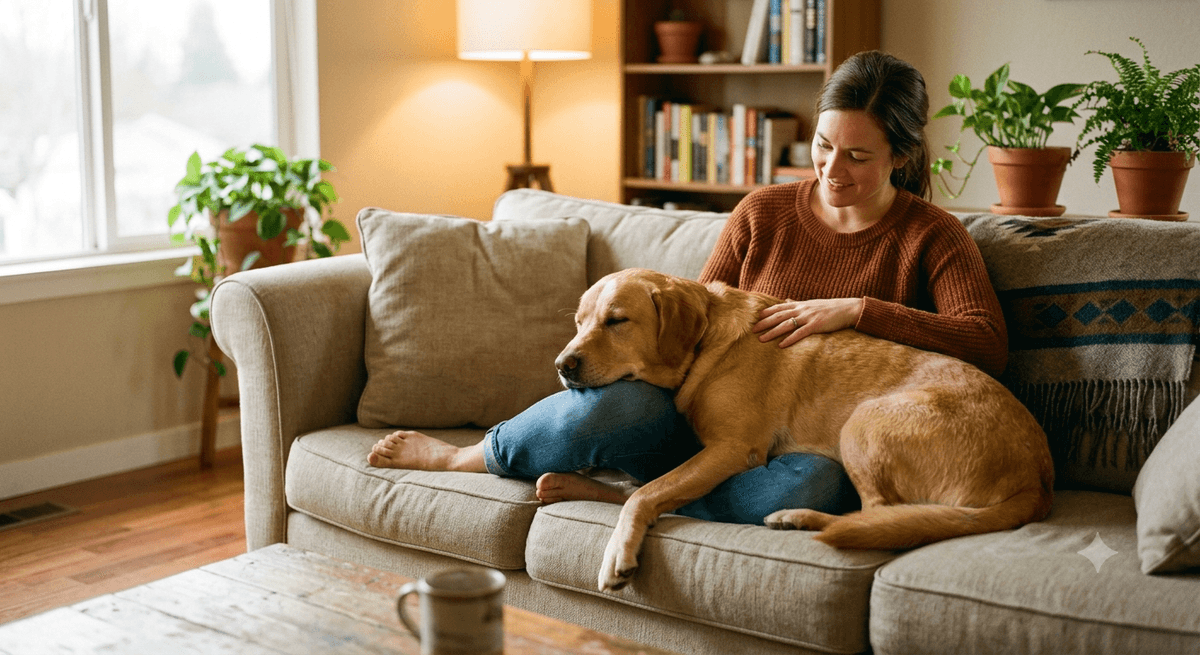
Velcro Dogs: The Real Science Behind Breeds That Never Leave Your Side
Every dog owner knows the type: the dog that follows you to the bathroom, lies against your feet under the desk, and treats a closed door as a personal crisis. Owners call them "velcro dogs." Science calls it something more specific — and more fascinating.
A 2015 study published in Science found that dogs and their owners release oxytocin, the same bonding hormone involved in the parent-infant bond, simply by gazing into each other's eyes for an extended period. Researchers ran the same test with hand-raised wolves and their human caretakers and found no such effect — this loop appears to be something dogs evolved specifically for us.
Some breeds lean into that loop harder than others. Here are five that were practically built for it, and the real research behind why.
Did You Know?
In the 2015 oxytocin study, dogs and owners who held a long, mutual gaze both showed a measurable rise in oxytocin — and giving dogs a dose of oxytocin directly made them gaze at their owners even longer, deepening the loop further. Researchers described it as a bonding pathway dogs may have effectively hijacked from human parent-infant attachment.
5 Breeds That Were Built to Stay Close
1. Vizsla
The Vizsla's nickname among breed clubs and owners is simply "the Velcro dog" — not a stretch, but the actual term used in breed descriptions. Developed in Hungary as a close-range hunting companion, the Vizsla was bred to work a short distance from its handler rather than ranging far out like a scent hound, which selected directly for a dog that wants to stay within arm's reach.
That history shows up in the breed's modern reputation: Vizslas are widely described as struggling with long stretches alone and preferring to be physically touching their person whenever possible, a trait breeders have maintained precisely because it made the dog a better hunting partner.
Why This Breed Sticks By Your Side
Bred specifically to hunt at close range beside a handler, not independently ahead of one.
Its "Velcro dog" nickname comes directly from breed clubs describing its constant physical closeness.
2. Labrador Retriever
Labs are the most popular breed in the country for a reason that goes beyond trainability: they are, genetically, some of the most reliably friendly dogs that exist. A 2017 study in Science Advances traced extreme canine sociability to structural variants in two genes — GTF2I and GTF2IRD1 — that are also linked to Williams-Beuren syndrome in humans, a condition marked by an unusually strong drive toward social closeness.
The researchers found these gene variants were far more common in dogs than in wolves, and directly associated with how much time a dog spent seeking out and staying near a person. Labradors, selected for generations to work in close partnership with fishermen and later families, sit solidly in the highly social end of that spectrum.
Why This Breed Sticks By Your Side
Linked to genetic variants shown to drive extreme sociability in dogs, more common in dogs than in wolves.
Bred for generations to work in close physical partnership with a person, not independently.
🐶 Want a Dog That's Always Close By? Or One That's Happy With Some Space?
Not everyone wants a shadow — and that's okay. PetMatch.ai's free 2-minute quiz matches you with real, available dogs based on how much closeness actually fits your life.
3. Weimaraner
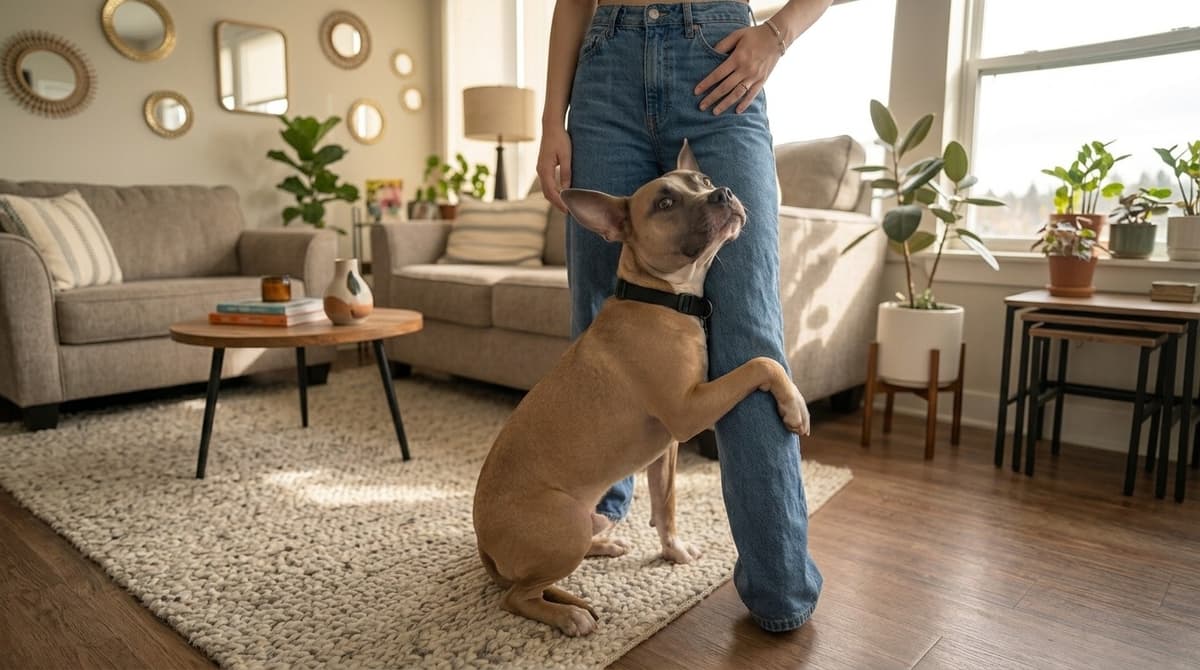
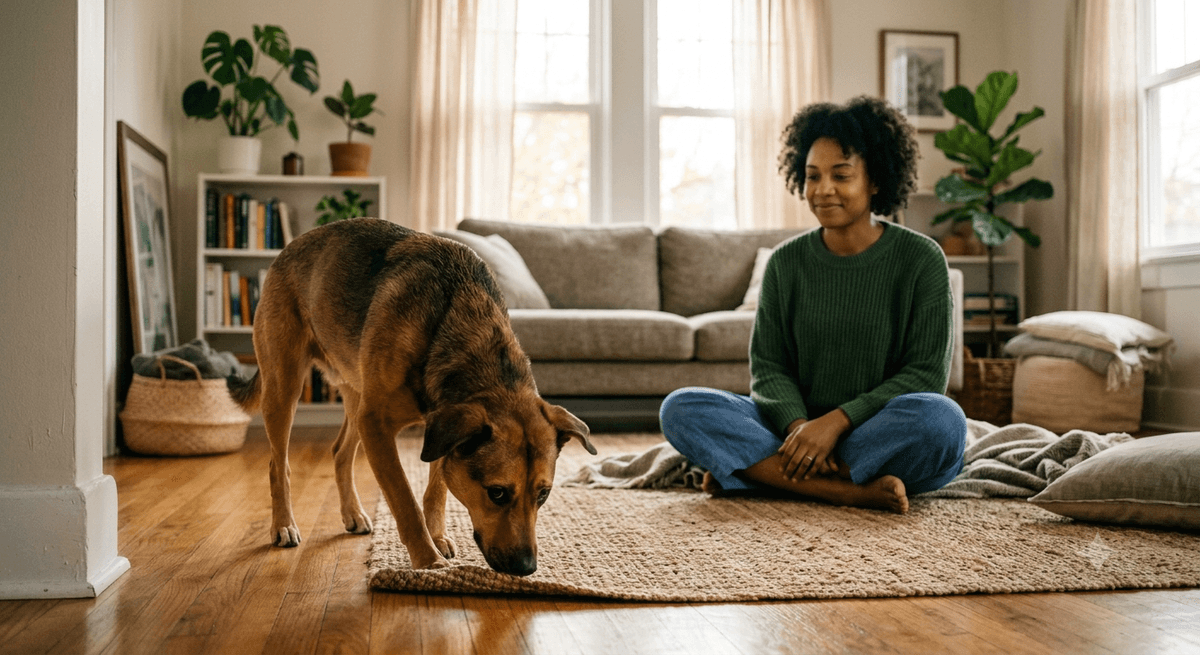
Nicknamed the "Grey Ghost" for its habit of silently appearing wherever its owner goes, the Weimaraner was developed in early 1800s Germany as an estate hunting dog for the aristocracy — and unusually for the era, these dogs were kept inside the home with the family rather than housed in outdoor kennels with other hunting breeds.
That early, close domestic integration is often cited as the root of the breed's famously intense attachment today. Weimaraners are known for shadowing their owner from room to room, and the breed is frequently flagged by trainers as prone to real difficulty when left alone without training toward independence.
Related Reading
Why This Breed Sticks By Your Side
One of the few historic hunting breeds kept indoors with the family rather than kenneled outside.
Its "Grey Ghost" nickname comes directly from its habit of silently following its owner room to room.
4. Great Pyrenees
Livestock guardian breeds like the Great Pyrenees were selected for a fundamentally different job than herding dogs: instead of controlling a flock's movement from a distance, they were bred to bond so completely with a flock — or a family — that they'd defend it as their own. Researchers studying livestock guardian dog behavior have long identified this deep, near-permanent attachment to whatever the dog is raised alongside as the single most important trait separating guardian breeds from working and herding breeds.
In a home setting, that same wiring redirects toward the family. A well-raised Great Pyrenees tends to treat its household the way its ancestors treated a flock: something to stay physically close to and watch over, almost around the clock.
Why This Breed Sticks By Your Side
Selected for deep, near-permanent attachment to whatever it's raised with — a defining trait of guardian breeds.
Redirects its historic flock-guarding instinct toward staying close to and watching over its human family.
5. Pembroke Welsh Corgi
Corgis were bred to herd cattle by working underfoot — low to the ground and directly among the animals' legs, close enough to nip at a heel and dodge a kick. That job required staying physically nearer to the herd, and to the shepherd, than most other herding breeds ever needed to.
The modern result is a dog famous for shadowing its owner around the house with the same low-to-the-ground persistence it once used on cattle. Queen Elizabeth II's decades of Corgi ownership only cemented the breed's reputation as a devoted, always-underfoot companion.
Why This Breed Sticks By Your Side
Bred to herd cattle at extremely close range, working directly among the animals rather than at a distance.
Carries that same close-proximity instinct into the home, often trailing its owner from room to room.
Is a Velcro Dog Actually Right for You?
A dog that never leaves your side sounds ideal until you're trying to shower, work from home on a call, or leave for a weekend. These breeds thrive on togetherness, but that same trait means they generally need more gradual alone-time training as puppies, and some — particularly the Vizsla and Weimaraner — are genuinely prone to separation-related stress if that training is skipped.
None of this makes velcro breeds high-maintenance in a bad way. It just means the fit works best for owners who are honestly home a lot, work from home, or want a dog that's part of nearly everything they do — not for someone who needs a dog comfortable with long solo stretches.
Sources
Nagasawa, M., et al. (2015). Oxytocin-gaze positive loop and the coevolution of human-dog bonds. Science, 348(6232), 333–336.
vonHoldt, B.M., et al. (2017). Structural variants in genes associated with human Williams-Beuren syndrome underlie stereotypical hypersociability in domestic dogs. Science Advances, 3(7), e1700398.
MacLean, E.L., & Hare, B. (2015). Dogs hijack the human bonding pathway. Science, 348(6232), 280–281.
American Kennel Club and national breed club standards — historical working roles and temperament descriptions.
Find a Dog Whose Attachment Style Matches Yours
Whether you want a constant shadow or a dog that's happy with a little independence, PetMatch.ai's 2-minute quiz matches you with real, available dogs based on how you actually live — not just which breed looks appealing in a photo.
Comments (0)
No comments yet. Be the first to share your thoughts!