Pit Bulls: The Most Misunderstood "Velcro Dog" Breed in America
Bring home a Pit Bull and you'll get a question, usually within the first week: "Why would you get one of those?" It's often asked with genuine concern, from people who like you and are surprised you own one — not hostility, just surprise.
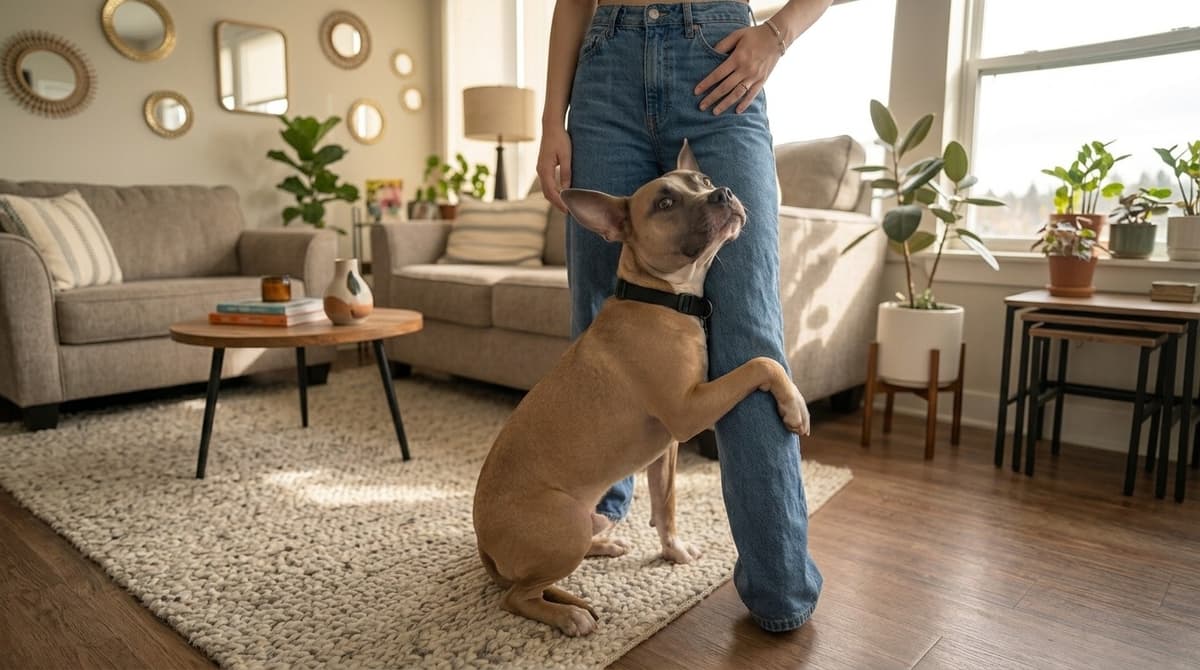
Meanwhile, the actual dog in your living room is doing something very different from what the reputation suggests: leaning its full body weight against your leg, following you between rooms, and generally acting like one of the clingiest, most human-focused breeds out there. That's not a coincidence, and it's not just your dog. It's one of the more well-documented and least publicized facts about the breed.
Did You Know?
The American Temperament Test Society has cumulatively tested thousands of dogs across more than 200 breeds since 1977. In that testing, American Pit Bull Terriers have consistently passed at rates around 85–87% — on par with or higher than many breeds widely seen as gentler family dogs, including Golden Retrievers and Border Collies.
Why the Reputation and the Reality Don't Match
The Pit Bull's history explains the gap directly. The breed descends from 19th-century British bull-and-terrier dogs used first in bull-baiting, then in organized dog fighting after baiting was banned in 1835. That history is real, and it did select hard for one trait: tenacity toward other animals in a fight.
But it selected just as hard, in the opposite direction, for a second trait that gets left out of the story: gentleness toward people. Handlers had to physically enter the pit and separate fighting dogs by hand. A dog that showed any aggression toward a person during that process was almost always removed from breeding lines on the spot. Generation after generation, that pressure bred human-directed aggression out of the line, even while dog-directed drive stayed in.
That history is written directly into the breed's modern standards: the American Dog Breeders Association and Old Family Red Nose Registry both list human aggression as an outright disqualifying fault, and the UKC standard describes the breed as "eager to please" and "brimming over with enthusiasm."
Breed ATTS Temperament Test Pass Rate American Pit Bull Terrier ~85–87% Golden Retriever ~85% Border Collie ~80% German Shepherd ~80%
Source: American Temperament Test Society cumulative data. ATTS notes this is raw testing data from self-selected dogs and owners, not a controlled scientific study — but the scale (thousands of dogs per breed) makes it one of the largest available temperament datasets.
🐶 Thinking About a Pit Bull — or Defending Your Choice to One?
PetMatch.ai's free 2-minute quiz matches you with real, available dogs based on actual temperament data, not breed stereotypes — so you can make the case with facts, not just love.
Related Reading



The "Nanny Dog" Nobody Remembers
Before the breed's reputation shifted in the 1980s, the American Pit Bull Terrier had a very different nickname: the "nanny dog," prized in the early 1900s specifically for its gentleness and patience with children. The breed served as a mascot for the U.S. in both World Wars — Sergeant Stubby, one of the most decorated dogs of World War I, was a Pit Bull — and appeared on the cover of Life Magazine three times.
A 2008 peer-reviewed study in Applied Animal Behaviour Science, which analyzed behavioral survey data across thousands of dogs, found that breed explained less than 10% of the variation in a dog's aggression — individual experience, socialization, and training accounted for far more. In other words, the research consistently points the same direction: what a dog experiences shapes its behavior more than which breed box it checks.
What This Means for the "Why Would You Get One?" Question
The honest answer isn't that Pit Bulls are perfect for everyone — they're strong, physical dogs that do best with an owner who trains and socializes consistently, same as any powerful breed. But the specific worry behind the question — that the breed is inherently dangerous or unaffectionate — isn't what the data shows.
What the data actually shows is a breed that was, quite literally, bred over generations to be gentle with the people around it, even under intense circumstances, while everything else about its temperament varied. The velcro-dog behavior your neighbor's Pit Bull shows isn't an exception to the breed. It's closer to the point of it.
Sources
American Temperament Test Society, Inc. (ATTS). Cumulative Breed Statistics, 1977–present. atts.org/breed-statistics
Duffy, D.L., Hsu, Y., & Serpell, J.A. (2008). Breed differences in canine aggression. Applied Animal Behaviour Science, 114(3–4), 441–460.
ASPCA. Position Statement on Pit Bulls. aspca.org
United Kennel Club (UKC) and American Dog Breeders Association (ADBA) official breed standards for the American Pit Bull Terrier.
Match With a Dog Based on Real Data, Not Reputation
PetMatch.ai's 2-minute quiz uses real temperament and lifestyle data — not breed stereotypes — to match you with a dog that actually fits your life.
Comments (0)
No comments yet. Be the first to share your thoughts!