Why These 3 Dog Breeds Frustrate Even Expert Trainers — and the Science of "Stubborn"
Every trainer has a story about the dog that just wouldn't listen. Three breeds come up again and again in these stories: the Siberian Husky, the Dachshund, and the Shar-Pei. Owners and professional trainers alike describe them as headstrong, independent, and slow to respond to commands that other breeds pick up in a session or two.
But here's what the research actually shows: none of these three breeds test as low-intelligence. What the data reveals instead is more interesting — a real, measurable, and largely genetic difference in how motivated a dog is to do what a person asks, separate from how capable it is of learning.
Did You Know?
Psychologist Stanley Coren's widely cited breed rankings measure something specific: "working and obedience intelligence," meaning how fast a breed learns commands and how reliably it obeys them. Coren himself noted that independent-minded breeds often score lower here not because they can't learn — but because they're less motivated to perform for a human audience in the first place.
3 Breeds That Test Smart but Train Hard
1. Siberian Husky
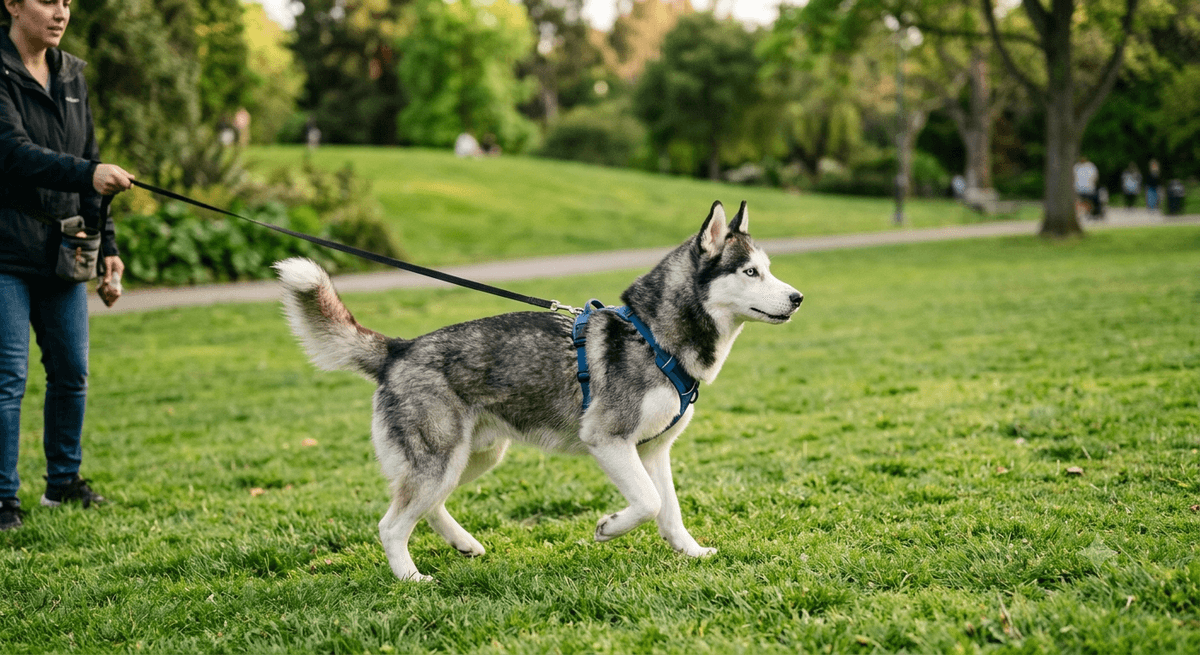
Huskies were bred to run in a team, cover long distances, and make independent decisions on the trail with minimal input from a musher — not to watch a handler's face for the next cue. That history shows up directly in Coren's data: Huskies land in his "average" obedience tier, needing roughly 25 to 40 repetitions to learn a new command and obeying a known one only about half the time on the first ask.
That's a meaningfully different profile from the top-tier working breeds, and it lines up with what sled-dog handlers have always known: a Husky's brain is built for solving problems on the move, at a distance from a person, not for checking in every few seconds.
The Science Behind the Struggle
Falls in Coren's mid-tier obedience band — not the lowest scores, but well below top trainers like the Border Collie or Poodle.
Bred for a working role (sled pulling) that rewards independent, in-the-moment decisions over constant human direction.
2. Dachshund
The Dachshund was purpose-built to track a scent underground and make its own call about a badger or fox in a tight burrow, often well out of a hunter's sight or hearing. Coren's rankings place the breed in the same mid-tier band as the Husky — again, not a low-intelligence result, but a low-compliance one.
That independent streak persists at home. A Dachshund left without enough to do tends to find its own project, and trainers consistently describe the breed as more responsive to high-value food rewards than to praise alone — consistent with a dog whose ancestors were never selected to work for a pat on the head.
The Science Behind the Struggle
Also falls in Coren's mid-tier obedience band, needing roughly 25 to 40 repetitions to learn a new command.
Bred for solitary scent-tracking work, a role that favors self-directed decision-making over responsiveness to a handler.
🐶 Not Every Dog Wants to Be Told What to Do — and That's Okay
Some dogs are built to check in constantly. Others are built to think for themselves. PetMatch.ai's free 2-minute quiz matches you with a real, available dog whose actual temperament — not just its looks — fits how you want to live and train.
3. Chinese Shar-Pei
The Shar-Pei's history as a Chinese farm guardian — herding livestock and protecting property with little day-to-day human direction — produced a breed described in its own official standard as "essentially independent and somewhat standoffish," even toward its own family until trust is earned. Coren's data places the Shar-Pei just below the Husky and Dachshund, still in the average tier rather than the bottom of the list.
The breed's caution around strangers is a related but separate trait from its trainability: guardian breeds are generally selected to evaluate a person before responding to them, which is a useful trait in a farm dog and a genuinely challenging one in an unsocialized house pet.
The Science Behind the Struggle
Scores in Coren's average obedience tier — intelligent, but not inclined to perform commands reflexively.
Descended from a guarding lineage that selected for wariness and independent judgment around strangers, not automatic compliance.
"Stubborn" Is Usually Just Independence, and It's Largely Genetic
A 2019 study in Proceedings of the Royal Society B, which analyzed behavioral data from more than 14,000 dogs across 101 breeds alongside each breed's genetic profile, found that traits like biddability — a dog's willingness to follow human direction — are highly heritable and track closely with a breed's genetic lineage. In other words, the "stubbornness" owners describe isn't a training failure; it's a trait these breeds were bred away from, not toward.
Separate research comparing cooperative breeds (like herding dogs and retrievers) to independent working breeds (like sighthounds, terriers, and guardian breeds) has consistently found that independent breeds are more likely to keep working at a problem on their own rather than looking to a person for guidance — the same behavior that shows up at home as ignoring a recall command in favor of investigating something more interesting.
What Actually Works With an Independent Breed
None of this means these breeds can't be trained — it means the approach has to match the dog. Trainers and behaviorists consistently recommend the same core strategy for independent breeds:
Start socialization and training early
Keep sessions short and varied so the dog doesn't disengage
Use high-value food rewards rather than praise alone
Stay consistent — these breeds are quick to notice when a rule is inconsistently enforced
The payoff is real: owners of all three breeds above describe deeply loyal, affectionate dogs once training clicks — the independence that makes the early work harder is often the same trait behind the loyalty that follows.
Sources
Coren, S. (1994; rev. 2006). The Intelligence of Dogs. Free Press. Ranking based on a survey of 208 obedience judges across North America.
MacLean, E. L., et al. (2019). Highly heritable and functionally relevant breed differences in dog behaviour. Proceedings of the Royal Society B, 286(1912).
Junttila, S., et al. (2023). Breed differences in social cognition, inhibitory control, and spatial problem-solving ability. Scientific Reports, 13, 1005. University of Helsinki.
Chinese Shar-Pei Club of America. Official Breed Standard (temperament section).
Find a Dog Whose Temperament Actually Fits You
Independent and low-maintenance, or eager-to-please and easy to train — PetMatch.ai's 2-minute quiz matches you with real, available dogs based on how you actually want to train and live, not just a breed's looks.
Comments (0)
No comments yet. Be the first to share your thoughts!