Am I Ready for a Dog? A Brutally Honest Self-Assessment
The dog does not care how much you wanted them. They care how much you are there.
That sentence is not meant to sting. It is meant to clarify. Because the question "am I ready for a dog" almost never gets an honest answer — not from well-meaning friends who just want to see you happy, not from shelter staff who are emotionally invested in placements, and often not from yourself, because wanting something and being ready for it can feel identical from the inside.
This article is going to ask you to be honest. Not about whether you love dogs. Of course you do. About whether your actual life — your actual Tuesday, not your imagined one — has room for what a dog genuinely needs.
This is not a test you pass or fail. It is a mirror. What you see in it is information, not judgment.
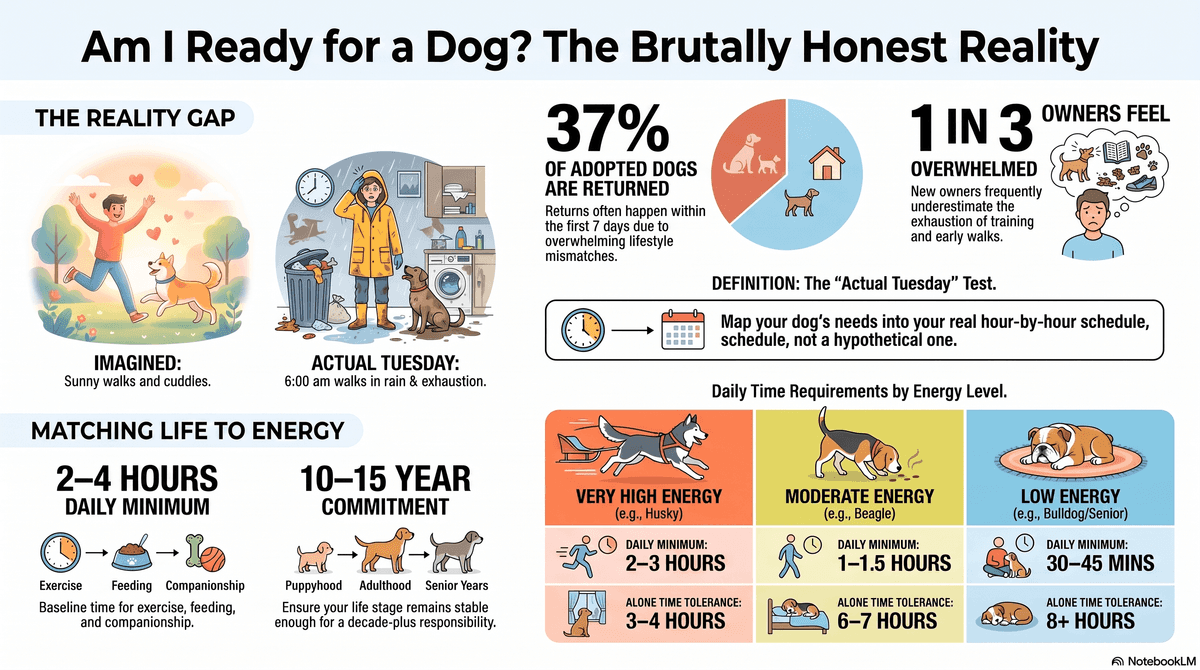
1 in 3
new owners feel overwhelmed in year one
37%
of adopted dogs returned within the first 7 days
2-4 hrs
minimum daily time most dogs genuinely need
10-15 yrs
average commitment length for a dog
Section 1: The Busy Owner Illusion
Almost everyone who gets a dog believes they have enough time. This is not dishonesty. It is a planning error that happens to nearly everyone.
Here is how it typically goes. Someone imagines their life with a dog — morning walks, evenings on the couch together, weekend hikes. They picture the good parts. They do not picture the 6am walk in the rain before a long workday, the dog whining at 4pm because the workday ran long, the cancelled plans because the dog has not been out enough, the exhaustion of training a young dog while also working a full-time job.
The gap between the imagined life and the actual life is where most dog-time mismatches happen. Not because people are lazy or uncommitted — because planning for a hypothetical is fundamentally different from living the reality.
The good news: this gap is entirely closeable. It just requires being honest about your calendar before you are honest about your heart.
The Reframe That Changes Everything:
Do not ask "do I want a dog?" You already know the answer to that. Ask instead: "What does my actual Tuesday look like, and where exactly does a dog fit into it?" Walk through your real schedule, hour by hour, and place the dog's needs into the gaps. If you cannot find the gaps, that is information — not failure.
Section 2: Minimum Time Commitments by Energy Level
Different dogs need genuinely different amounts of your time. This is not a minor detail — it is one of the most important compatibility factors there is, and it is consistently underestimated.
Energy Level Daily Min. Alone OK Examples Very High 2-3 hours 3-4 hours Border Collie, Vizsla, Husky High 1.5-2 hours 5-6 hours Lab, Aussie Shepherd, GSD Moderate 1-1.5 hours 6-7 hours Beagle, Cocker Spaniel Low-Moderate 45-60 min 6-8 hours Cavalier, Bichon Low 30-45 min 8+ hours Senior dogs, Basset, Bulldog
Two numbers in that table matter more than any other factor in this entire article: your realistic daily activity time, and your realistic daily alone time. Be honest about both. A dog in the "Very High" category left alone 8 hours a day with a 20-minute walk is not a mismatch waiting to happen. It already is one.
Section 3: The WFH Shift and What It Actually Meant for Dogs
A huge amount of dog adoption decisions made in the past several years were shaped by a temporary reality that has since changed for many people.
During the height of remote work, getting a dog made enormous sense for a huge number of households — someone was almost always home. Dogs adopted during that period bonded to a routine of constant companionship.
Since then, return-to-office mandates have reshaped that reality for a large share of the workforce. People who got a dog in 2021 under one set of life circumstances may now be living under a completely different one — and the dog is the one absorbing the gap.
If you are currently working from home and considering a dog, ask yourself honestly: is this arrangement permanent, or could it change? If there is meaningful uncertainty about your future work location, factor that uncertainty into your decision. A dog adopted under WFH conditions and later left alone 9 hours a day without any transition plan is one of the most common and most preventable sources of separation anxiety in America today.
The Honest Question for WFH Adopters:
If my employer called me back to the office full-time next month, would this dog still be a good match for my life? If the honest answer is no, consider either waiting, choosing a more independent breed, or building a support plan — daycare, a dog walker, a flexible arrangement — before you adopt, not after.
Section 4: The Honest Checklist — 10 Questions
Answer each of these as specifically and honestly as you can. There are no right answers — only honest and dishonest ones.
Related Reading

10 Honest Questions Before Getting a Dog
What time do I actually wake up on a weekday, and what time do I actually leave the house?
How many hours, realistically, will a dog be alone on a typical weekday? Be specific — include commute time.
When I picture walking a dog, am I picturing a nice day, or am I picturing the worst weather day of the year, every single day, for the next 10-15 years?
In the last month, how many evenings did work, social plans, or exhaustion take priority over a planned activity?
Do I have a realistic plan for the dog during work hours — daycare, a walker, a flexible schedule — or am I assuming it will work itself out?
How do I handle unexpected disruptions to my routine? Dogs need consistency, and life will not always cooperate.
Have I budgeted realistic time for training — not just in week one, but as an ongoing practice for months?
What does my travel pattern actually look like, and do I have a real plan and budget for pet care during those trips?
Is my current life stage stable, or am I expecting a major change in the next 1-2 years — a move, a new job, a relationship change, a baby?
If I am honest with myself, am I getting a dog because my life genuinely has room for one, or because I want to feel like the kind of person who has a dog?
How to Score Yourself:
This is not a points system. Read back through your answers. If most of them reveal a life with genuine, consistent space for a dog's needs — you are likely ready, and the next step is finding the right match for your specific schedule. If several answers reveal real gaps — inconsistent time, no backup plan, major life instability — that is not a permanent no. It is information about timing. Waiting six months until your life stabilizes is not a failure. Adopting into chaos and returning the dog four months later is much harder on everyone, including the dog.
Section 5: Dogs That Genuinely Work for Busy Lives — With Real Caveats
If your honest self-assessment reveals a genuinely busy life, that does not automatically mean no dog. It means a different kind of dog — chosen with the same honesty you just applied to yourself.
Lower-energy adult or senior dogs
A 7-year-old Greyhound or a calm adult mixed breed from a foster home with a documented quiet history can genuinely fit a busy life. The match is about energy level and alone-time tolerance, not just breed. Senior dogs in particular often do well with a reliable routine and a long daily walk — no 2-hour runs required.
Independent-natured breeds with structured support
Some breeds tolerate solo time better than others — but "tolerate" still requires a real plan. Even independent dogs need a midday break, a dog walker, or daycare if you are gone more than 6-7 hours regularly. Independence is not the same as needing nothing.
The honest non-dog option
If your assessment reveals a life that genuinely cannot support a dog right now — frequent travel, unpredictable hours, major life instability — that is real information worth respecting. Fostering, volunteering at a shelter, or simply waiting until your life changes are not consolation prizes. They are responsible choices that protect a dog from becoming another statistic in the 37% returned within the first week.
The Bottom Line
Being ready for a dog is not about loving dogs enough. Everyone reading this loves dogs enough. It is about whether your actual daily life — not your imagined one — has consistent room for what a dog genuinely needs.
That assessment is not a judgment of your worth as a person or even your worth as a future dog owner. It is information. And information, used honestly, is what prevents the heartbreak of a dog who ends up back in a shelter because the timing was wrong before it ever began.
If your honest answers point to yes — wonderful. The next step is finding the dog whose specific needs match your specific life, not just any dog that happened to catch your eye.
If your honest answers point to not yet — that is not a closed door. It is useful information about timing, and there are meaningful ways to be part of a dog's life without bringing one home today.
PetMatch.ai was built around this exact kind of honesty — matching real schedules to real dogs, so the decision to adopt is made with clear eyes from the very beginning.
Find Out If You Are Ready — Free at PetMatch.ai
Take the full 2-minute assessment and get an honest answer about your readiness, plus matches with dogs whose needs genuinely fit your real schedule — not your imagined one.
Comments (0)
No comments yet. Be the first to share your thoughts!