How Much Does a Dog Actually Cost in 2026? The Full Breakdown by Breed
The adoption fee is the cheapest thing you will pay.
That is not a warning. That is just math.
A shelter dog might cost you $75 to adopt. A rescue dog, maybe $250. A purebred puppy from a responsible breeder, anywhere from $800 to $3,500. People see those numbers and think they have done the hard financial math.
They have not.
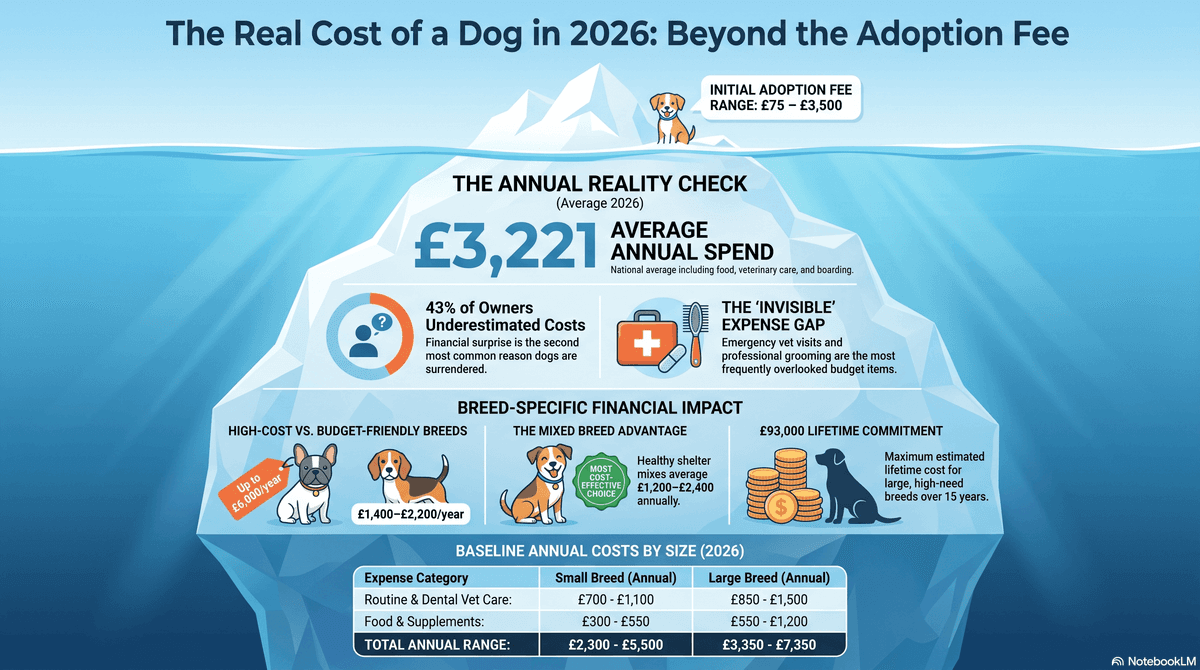
The actual cost of owning a dog in 2026 — when you add up food, veterinary care, grooming, training, boarding, supplies, and the inevitable emergencies — runs between $1,500 and $10,000 per year depending on the breed, your location, and your choices. Over the lifetime of a dog, you are looking at anywhere from $15,000 to $93,000.
That is not a reason not to get a dog. Dogs are worth every dollar. But financial surprise is the second most common reason dogs are surrendered to shelters — right behind personality mismatch. And financial surprise is entirely preventable if you know the real numbers going in.
This article gives you the real numbers. No rounding down. No leaving out the inconvenient parts.
$3,221
average annual dog ownership cost in 202643%
of owners say cost exceeded expectations#2
financial strain is the #2 reason for surrender$93K
estimated lifetime cost for large, high-need breeds
Section 1: What People Budget vs. What They Actually Spend
A 2026 survey by the American Pet Products Association found that the average American dog owner spends $3,221 per year on their dog. That number surprises most people — including people who already own dogs.
Here is why the gap exists between what people expect and what they spend.
When someone decides to get a dog, they typically think about the obvious costs: food, a collar and leash, maybe a crate. They might factor in annual vet visits. What they almost never fully account for:
Emergency veterinary care — the single largest unexpected expense category
Dental care — one of the most commonly skipped but medically necessary annual procedures
Professional training — especially in year one, when getting this right saves you years of problems
Boarding or dog-sitting every time you travel
Grooming — which varies wildly by breed but is non-optional for many
The slow creep of premium food, supplements, and care upgrades as the dog ages
None of these are extravagant choices. They are the baseline cost of responsible dog ownership. And most of them are invisible until they happen.
The APPA 2026 Ownership Cost Breakdown (National Average):
Veterinary care (routine): $410/year
Veterinary care (surgical/emergency): $458/year average — but can be $3,000-$8,000 in a single event
Food: $442/year
Grooming: $383/year
Training: $182/year
Boarding/pet-sitting: $612/year
Supplies, toys, accessories: $124/year
Flea/tick/heartworm prevention: $210/year
Total average: $3,221/year — and this is the average, not the high end.
Section 2: The Real Cost Breakdown — Every Category, Honestly
Food
Budget dogs food ranges from $20 to $100+ per month depending on size and quality. A 15-pound dog eating a mid-tier kibble costs around $30-$50 per month. A 70-pound dog on a high-quality diet can cost $80-$120 per month. Raw or fresh food diets (brands like The Farmer's Dog or Nom Nom) run $100-$300 per month.
Rule of thumb: larger dog equals larger food bill. Always. And quality food prevents some vet bills — which makes it an investment, not just an expense.
Routine veterinary care
Annual wellness exams, core vaccines, flea/tick/heartworm prevention, and a yearly dental cleaning are the baseline. In 2026, a single annual wellness visit in most US metro areas runs $250-$450. A dental cleaning under anesthesia — which most dogs need annually or every other year — adds another $300-$800.
If you skip dental care, expect periodontal disease by age 5-6 in most breeds. The resulting extractions are more expensive than the cleanings you skipped.
Emergency and unexpected veterinary care
This is the number that breaks people's budgets. The average pet emergency vet visit in 2026 costs $800-$1,500 just to walk through the door and be assessed. A surgery, hospitalization, or specialist referral can quickly reach $3,000-$10,000.
Common emergencies that catch owners off guard: swallowed foreign objects (very common in Labs and Goldens), ACL tears ($3,500-$6,000 per knee), bloat in large deep-chested breeds ($3,000-$8,000 and a true life emergency), cancer treatment in older dogs, and allergic reactions.
Pet insurance or a dedicated emergency fund of $2,000-$3,000 is not optional if you want to avoid a devastating financial decision in a moment of crisis.
Grooming
This is the most breed-variable cost. Some dogs — short-coated breeds like Beagles, Boxers, or Vizslas — need minimal professional grooming. An occasional bath and nail trim might cost $30-$60 every few months.
Long-coated and curly-coated breeds are a completely different story. Doodles, Poodles, Bichons, Shih Tzus, and Maltese require professional grooming every 6-8 weeks to prevent painful matting. A full groom in 2026 runs $65-$150 depending on size and coat condition. Over a year, that is $500-$1,200 in grooming alone — minimum.
This cost is non-negotiable. Skipping it does not save money. It creates coat problems that cost more to fix.
Training
Year one training is the single best investment you will make in your dog relationship. A good group obedience class runs $150-$300 for 6-8 weeks. Private training sessions cost $75-$200 per hour. A board-and-train program, useful for serious behavior issues, runs $1,500-$4,000.
Owners who skip training in year one consistently report higher costs later — in destroyed property, vet bills from behavior-related injuries, and professional behavior intervention.
Boarding and pet-sitting
The APPA data shows boarding and pet-sitting is the most underestimated ongoing cost. If you travel even four times per year for an average of 5 days per trip, you are looking at 20 dog-days per year. A quality dog boarding facility runs $40-$80 per night in most markets. A professional in-home pet sitter runs $25-$50 per visit.
That is $800-$1,600 per year, every year, just for your travel — before any unexpected trips.
Section 3: Breed-by-Breed Cost Reality — The Numbers Nobody Posts
Not all dogs cost the same to own. Breed choice is also a financial choice. Here is an honest look at the annual and lifetime costs for six common breeds that represent very different ownership cost profiles.
Beagle — The Affordable Middle Ground
AVERAGE ANNUAL COST: $1,400-$2,200/year
COMMON SURPRISE COSTS: Ear infections (floppy ears trap moisture — budget $200-$400/year if prone). Obesity-related costs if diet not managed. Occasional hip issues in older age.
ESTIMATED LIFETIME COST: $14,000-$24,000 over 12-15 year lifespan
Golden Retriever — Beloved but Budget-Heavy
AVERAGE ANNUAL COST: $2,800-$4,500/year
COMMON SURPRISE COSTS: Cancer affects nearly 60% of Goldens — cancer treatment can run $5,000-$20,000. Hip dysplasia surgery: $3,500-$6,500 per hip. Heart conditions common in later years.
ESTIMATED LIFETIME COST: $28,000-$65,000 over 10-12 year lifespan
French Bulldog — High Purchase Price, Higher Ownership Cost
AVERAGE ANNUAL COST: $3,500-$6,000+/year
COMMON SURPRISE COSTS: Brachycephalic airway surgery: $2,000-$5,000 (often needed). Spinal problems (IVDD): $3,000-$8,000. Skin fold infections require ongoing management. Cannot regulate body heat — limits outdoor activity.
ESTIMATED LIFETIME COST: $35,000-$72,000 over 10-12 year lifespan
Related Reading


Labrador Retriever — Popular, Predictable, Mid-Cost
AVERAGE ANNUAL COST: $2,200-$3,800/year
COMMON SURPRISE COSTS: Joint problems and hip dysplasia are very common. ACL tears run $3,500-$6,000 per leg. Obesity is the breed's biggest health risk and leads to cascading costs if not managed.
ESTIMATED LIFETIME COST: $22,000-$45,000 over 10-12 year lifespan
Standard Poodle — High Grooming, Lower Medical Costs
AVERAGE ANNUAL COST: $2,000-$3,200/year
COMMON SURPRISE COSTS: Bloat (GDV) is a life-threatening emergency costing $3,000-$8,000 if it occurs. Addison's disease is breed-common: $1,000-$2,000/year in ongoing management once diagnosed.
ESTIMATED LIFETIME COST: $20,000-$38,000 over 12-15 year lifespan
Mixed Breed (Medium Size, Shelter Adopted) — The Cost-Smart Choice
AVERAGE ANNUAL COST: $1,200-$2,400/year
COMMON SURPRISE COSTS: Hybrid vigor means generally lower breed-specific health risks. Dental care still applies. Emergency vet costs are the same regardless of breed. Low or no grooming costs for short-coated mixes.
ESTIMATED LIFETIME COST: $12,000-$29,000 over 12-15 year lifespan
Section 4: The Hidden Costs — What Almost Nobody Budgets For
Beyond the predictable categories, there are costs that consistently blindside new dog owners. These are not rare events. They happen to most dog owners at some point.
Pet insurance — the math in 2026
Pet insurance premiums in 2026 run $30-$100 per month depending on breed, age, deductible, and coverage level. That is $360-$1,200 per year. Most owners calculate this against routine costs and decide it is not worth it.
The math changes completely when something goes wrong. A single ACL surgery, cancer diagnosis, or gastrointestinal emergency that costs $5,000-$10,000 makes $600/year in premiums look very different. The families who get hit without insurance often face impossible choices.
Buy insurance when the dog is young and healthy, before any conditions are diagnosed. Pre-existing conditions are not covered.
Lost income and lifestyle costs
Owning a dog changes your schedule. You cannot stay late at the office without arranging care. Spontaneous overnight trips require planning and cost. Some apartments charge monthly pet fees of $25-$75 in addition to a one-time pet deposit. These costs are real but almost never appear in any dog ownership budget guide.
Property costs and deposits
Pet deposits typically run $200-$500. Monthly pet rent adds $25-$75 in many markets. If your dog damages a rental property, you are responsible for repair costs. Carpet replacement alone can run $1,500-$4,000 in a two-bedroom apartment.
End-of-life care
This is the cost no one wants to talk about and almost no one budgets for. Palliative care, pain management, and quality-of-life support for a dog in their final months can cost $200-$500 per month. Euthanasia itself runs $50-$300 depending on whether it is done at a clinic or at home. Cremation services add $100-$400.
This is a real cost. Acknowledging it is part of honest ownership planning.
The Budget Formula That Actually Works:
YEAR ONE (highest cost year): Adoption or purchase + spay/neuter + all vaccines + microchip + supplies + training class + first annual exam. Budget: $2,500-$5,000 minimum
ONGOING ANNUAL BUDGET (years 2-8): Food + routine vet + grooming + boarding + supplies + prevention. Budget: $1,500-$4,500/year depending on breed
EMERGENCY FUND (keep liquid, always): Minimum $2,000-$3,000 in a dedicated account OR active pet insurance
SENIOR YEARS (age 8+): Add $500-$1,500/year for increased vet frequency, dental care, and potential medications
Section 5: Cost as a Compatibility Factor — How PetMatch Uses It
At PetMatch, we treat budget honestly — as a real compatibility variable, not as something to feel guilty about.
If your realistic annual pet budget is $1,500, that is a real number. It does not make you a bad dog owner. It makes you someone who should not adopt a French Bulldog or a breed with known expensive health issues. It makes you someone whose best match is probably a short-coated, healthy mixed breed or a smaller dog with low grooming demands and strong genetics.
If your budget is $4,000+ per year, that opens up the full range — including breeds whose health profiles or grooming needs carry a higher ongoing cost.
Neither answer is wrong. The wrong answer is pretending you have more than you do, adopting anyway, and discovering the gap when a $4,000 vet bill arrives.
What PetMatch Asks About Cost:
We ask your realistic monthly pet budget — not what you wish it were, but what you can actually sustain every single month for 12-15 years.
We then filter your matches to show breeds and individual dogs whose typical annual cost falls within a realistic range for your stated budget.
This means your top matches will not just fit your personality and lifestyle — they will fit your financial reality too.
Section 6: The Annual Cost Comparison Table — At a Glance
Here is the full honest comparison across the most common expense categories for small versus large breeds in 2026. Use this as your planning baseline.
Expense CategorySmall Breed / YearLarge Breed / YearFood$300-$550$550-$1,200Routine vet care$400-$600$450-$700Dental cleaning$300-$500$400-$800Emergency fund (annual contribution)$300-$500$500-$1,000Grooming (breed-dependent)$0-$1,200$100-$600Training (year one)$150-$500$200-$600Boarding / pet-sitting$600-$1,200$800-$1,800Flea / tick / heartworm prevention$150-$250$200-$350Supplies, toys, replacements$100-$200$150-$300ANNUAL TOTAL RANGE$2,300-$5,500$3,350-$7,350
These are ranges. Your actual costs depend on your location, your choices, your dog's health, and whether you face any major medical events. The low end assumes a healthy dog in a lower cost-of-living market. The high end reflects a dog with moderate health needs in a metro area.
Neither the low end nor the high end is guaranteed. What is guaranteed is that surprises will happen. The families who plan for them come through fine. The ones who do not face the hardest decisions at the worst moments.
The Bottom Line
The real cost of owning a dog in 2026 is $1,500 to $10,000 per year depending on breed, health, location, and choices. Over a lifetime, you are looking at $15,000 to $93,000.
Those numbers are not meant to scare you out of getting a dog. They are meant to make you the kind of owner who is ready — financially and practically — for what is actually coming.
The families who go in with eyes open, who budget honestly, and who choose a breed whose cost profile matches their financial reality are the families whose dogs are still with them twelve years later.
PetMatch.ai builds cost into your compatibility profile from the beginning. Because finding the right dog means finding a dog your whole life can support — including your budget.
Get Matched to a Dog Your Budget Can Support — Free at PetMatch.ai
PetMatch factors in your realistic annual pet budget alongside your lifestyle, schedule, and experience. Your matches will include the estimated annual cost range for each breed or dog — so you can make a fully informed decision before you fall in love.
Comments (0)
No comments yet. Be the first to share your thoughts!